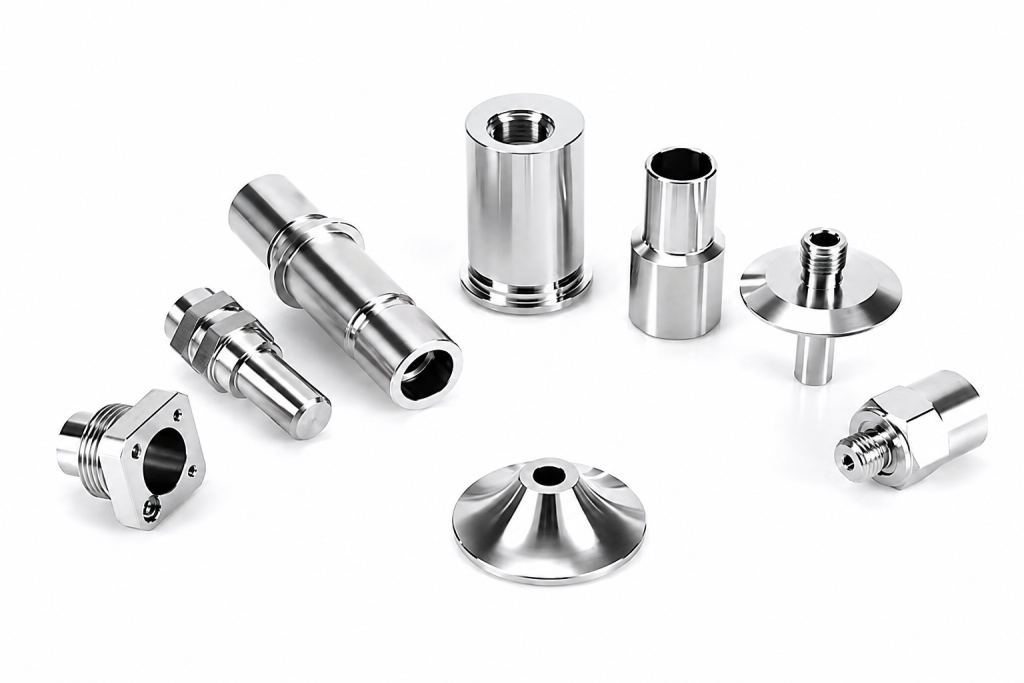
Stainless Steel

Stainless Steel

Price:

Lead Time:

< 10 days

Wall Thickness:

0.75 mm

Tolerances:

±0.005″ (±0.125mm)
Max Part Size:
200 cm x 80 cm x 100 cm

Stainless Steel 201

‌‌Properties‌‌: Low-nickel Cr-Mn-Ni alloy (Cr 16-18%, Mn 5.5-7.5%, Ni 3.5-5.5%), moderate corrosion resistance, magnetic, work-hardening grade. ‌‌Applications‌‌: Kitchenware, sinks, decorative trims, railway carriages.

Tensile Strength, Yield (MPa)
Fatigue Strength (MPa)
Elongation at Break (%)
VHardness (Brinell)
Density (g/cm³)
515-760
240
40-55
200-250
7.93

Stainless Steel 301

‌‌Properties‌‌: High-strength Cr-Ni alloy (Cr 16-18%, Ni 6-8%), excellent ductility when annealed, work-hardens rapidly. ‌‌Applications‌‌: Automotive structural parts, aircraft components, springs.
Tensile Strength, Yield (MPa)
Fatigue Strength (MPa)
Elongation at Break (%)
VHardness (Brinell)
Density (g/cm³)
515-930
260
40-60
200-250
7.93

Stainless Steel 303

‌‌Properties‌‌: Free-machining Cr-Ni-S alloy (Cr 17-19%, Ni 8-10%, S ≥0.15%), lower corrosion resistance than 304 due to sulfur. ‌‌Applications‌‌: Shafts, nuts, bolts, fittings requiring extensive machining.

Tensile Strength, Yield (MPa)
Fatigue Strength (MPa)
Elongation at Break (%)
VHardness (Brinell)
Density (g/cm³)
500-750
220
35-50
180-220
7.93

Stainless Steel 304

‌‌Properties‌‌: Standard 18/8 Cr-Ni alloy (Cr 18-20%, Ni 8-10.5%), excellent corrosion resistance, non-magnetic when annealed. ‌‌Applications‌‌: Food processing equipment, chemical containers, architectural cladding.

Tensile Strength, Yield (MPa)
Fatigue Strength (MPa)
Elongation at Break (%)
VHardness (Brinell)
Density (g/cm³)
515-720
240
40-60
160-200
7.93

Stainless Steel 304L

‌‌Properties‌‌: Low-carbon variant of 304 (C ≤0.03%), reduced carbide precipitation, better weldability. ‌‌Applications‌‌: Welded structures, pharmaceutical tanks, heat exchangers.

Tensile Strength, Yield (MPa)
Fatigue Strength (MPa)
Elongation at Break (%)
VHardness (Brinell)
Density (g/cm³)
485-680
230
45-60
150-190
7.93

Stainless Steel 316

‌‌Properties‌‌: Mo-added Cr-Ni alloy (Cr 16-18%, Ni 10-14%, Mo 2-3%), superior pitting resistance. ‌‌Applications‌‌: Marine hardware, medical implants, coastal architecture.

Tensile Strength, Yield (MPa)
Fatigue Strength (MPa)
Elongation at Break (%)
VHardness (Brinell)
Density (g/cm³)
515-690
260
40-50
170-220
7.98

Stainless Steel 316L

‌‌Properties‌‌: Low-carbon 316 (C ≤0.03%), enhanced weldability and corrosion resistance. ‌‌Applications‌‌: Chemical processing pipelines, nuclear reprocessing units.

Tensile Strength, Yield (MPa)
Fatigue Strength (MPa)
Elongation at Break (%)
VHardness (Brinell)
Density (g/cm³)
485-620
250
45-55
160-200
7.98

Stainless Steel 403

‌‌Properties‌‌: Ferritic Cr alloy (Cr 16-18%), magnetic, moderate corrosion resistance, poor weldability. ‌‌Applications‌‌: Appliances, automotive trim, low-cost cutlery.

Tensile Strength, Yield (MPa)
Fatigue Strength (MPa)
Elongation at Break (%)
VHardness (Brinell)
Density (g/cm³)
450-600
180
20-25
150-180
7.70

pros

  • Corrosion Resistance: Exceptional resistance to rust and corrosion, ideal for harsh environments. This makes it suitable for a wide range of outdoor and indoor applications, including those involving extreme temperatures and pressures.
  • High Strength: Robust mechanical properties compared to mild steel, brass, and various aluminum alloys to ensure durability under stress.
  • Versatile Applications: Suitable for industries ranging from aerospace to medical devices.
  • Recyclability: Eco-friendly, as stainless steel can be recycled without degradation.
  • Aesthetic Appeal: Thanks to its high chromium content, stainless steel maintains a silver-white appearance that neither discolors nor rusts over time.
  • Cryogenic Resistance: Certain grades of stainless steel remain stable across a wide range of temperatures. Austenitic steels retain excellent toughness and enhanced tensile strength even at sub-zero temperatures.

cons

  • Cost: Higher initial cost compared to some other metals, but offers long-term value.
  • Machining Challenges: Some grades can be difficult to machine, requiring specialized tools and techniques.
  • Tendency for Overheating: Stainless steel is a poor conductor of heat compared to many other metals. However, during machining, it heats up quickly, which can damage both the material and the tools or CNC machines used.
  • Technical Expertise Required: Machining stainless steel requires significant technical skill and consideration. The process is challenging because incorrect cutting tools or speeds can damage the material.
Parts Delivered Into Supply Chains Including