Brass

Brass

Price:

Lead Time:

< 7 days

Wall Thickness:

0.75 mm

Tolerances:

±0.005″ (±0.125mm)
Max Part Size:
200 cm x 80 cm x 100 cm

Brass H59

A cost-effective brass alloy with 59% Cu and 41% Zn, offering moderate strength and machinability. Suitable Processes‌: Hot forging, Sheet metal stamping, CNC machining. Applications‌: Hardware fittings, plumbing components, and structural parts requiring cost-effective brass solutions.
Tensile Strength, Yield (MPa)
Fatigue Strength (MPa)
Elongation at Break (%)
VHardness (Brinell)
Density (g/cm³)
180
120-150
25
100-163HB
8.4

Brass H62

A versatile brass alloy (60-63% Cu, Zn balance) with balanced strength and ductility. Suitable Processes‌: Cold working, deep drawing, soldering. Applications‌: Locks, hinges, electrical connectors, and radiator cores.
Tensile Strength, Yield (MPa)
Fatigue Strength (MPa)
Elongation at Break (%)
VHardness (Brinell)
Density (g/cm³)
250-350
140-170
≥2.5~35
80-115HB
8.5

Brass H63

A brass variant (62-65% Cu) with improved corrosion resistance for marine environments. Suitable Processes‌: Extrusion, welding, polishing. Applications‌: Marine hardware, decorative trim, and musical instruments.
Tensile Strength, Yield (MPa)
Fatigue Strength (MPa)
Elongation at Break (%)
VHardness (Brinell)
Density (g/cm³)
240-400
2.5~35
≤187HB
8.4~8.7

Brass H65

A high-ductility brass (64-67% Cu) ideal for precision forming. Suitable Processes‌: Spinning, bending, stamping. Applications‌: Cartridge casings, springs, and flexible hoses.
Tensile Strength, Yield (MPa)
Fatigue Strength (MPa)
Elongation at Break (%)
VHardness (Brinell)
Density (g/cm³)
200-300
160-190
≥4~40
50~80HB‌
8.4~8.7

Brass H68

A deep-drawing brass (67-70% Cu) with excellent fatigue resistance. Suitable Processes‌: Deep drawing, annealing, CNC turning. Applications‌: Radiator fins, battery caps, and ammunition casings.
Tensile Strength, Yield (MPa)
Fatigue Strength (MPa)
Elongation at Break (%)
VHardness (Brinell)
Density (g/cm³)
205
180-220
10~15
90~120HB
8.5

Brass H70

A cold-working brass (69-72% Cu) with superior surface finish capabilities. Suitable Processes‌: Roll forming, etching, plating. Applications‌: Electronic shielding, jewelry, and precision gears.
Tensile Strength, Yield (MPa)
Fatigue Strength (MPa)
Elongation at Break (%)
VHardness (Brinell)
Density (g/cm³)
205
130-160
18~43
100~150HB
8.5

Brass H80

A high-strength brass (79-81% Cu) with wear resistance. Suitable Processes‌: Casting, machining, grinding. Applications‌: Bearings, bushings, and heavy-duty valve components.
Tensile Strength, Yield (MPa)
Fatigue Strength (MPa)
Elongation at Break (%)
VHardness (Brinell)
Density (g/cm³)
220~350
≥30
80~120HB
8.4~8.7

Brass H90

A near-red brass (89-91% Cu) with thermal conductivity close to pure copper. Suitable Processes‌: Brazing, hot forming, engraving. Applications‌: Heat exchangers, coinage, and artistic engravings.
Tensile Strength, Yield (MPa)
Fatigue Strength (MPa)
Elongation at Break (%)
VHardness (Brinell)
Density (g/cm³)
280~400
90-120
≥30
40~100HB
8.4~8.7

Brass H96

A high-purity brass (95-97% Cu) with exceptional electrical conductivity. Suitable Processes‌: Wire drawing, EDM, polishing. Applications‌: Electrical waveguides, conductive springs, and premium decorative items.

Tensile Strength, Yield (MPa)
Fatigue Strength (MPa)
Elongation at Break (%)
VHardness (Brinell)
Density (g/cm³)
300~450
≥45
80-120 HB
8.4~8.7

Surface Finishing Options for Brass

Brass CNC turned parts can undergo various surface finishing processes to enhance their appearance, durability, and performance.
As Machined
Alodine

Black Oxide

Electroless Plating

Heat Treatment

Knurling

Polishing

Sand blasting

pros

  • Exceptional Machinability: Brass is highly machinable, allowing for precise and efficient machining.
  • Corrosion Resistance: It offers high resistance to corrosion, making it suitable for harsh environments.
  • Aesthetic Appeal: Its appearance is attractive and ideal for decorative and aesthetic applications.
  • Good Conductivity: Brass has excellent thermal and electrical conductivity.
  • Versatility: Brass can also be used in various industries, from electronics to plumbing.

cons

  • Flexibility: Easily deforms under mechanical stress, making it difficult to maintain high-precision dimensional tolerances.
  • Adhesion: Tends to adhere to the tool during machining, affecting workpiece surface quality and accelerating tool wear.
  • High Cost: Raw material and overall processing costs are significantly higher than common structural metals.
  • High Thermal Expansion: Significantly affected by temperature changes, potentially causing dimensional fluctuations, requiring compensation during machining and assembly.

Applications of CNC machining of copper parts

copper parts primarily utilizes the unique physical properties of copper alloys, playing an irreplaceable role in demanding functional applications. Unlike aluminum alloys, which prioritize lightweighting and structural strength, CNC machining focuses on electrical and thermal conductivity, corrosion resistance, and aesthetic decoration.

The following are the core application areas for CNC-machined copper parts:

  • Electrical Engineering: Wiring, connectors, and circuit components.

  • Thermal Management: Heat exchangers, radiators, and heat sinks.

  • Automotive: Radiators, electrical systems, and sensor components.

  • Aerospace: High-performance electrical connectors and thermal management systems.

  • Medical: Surgical instruments and imaging equipment.
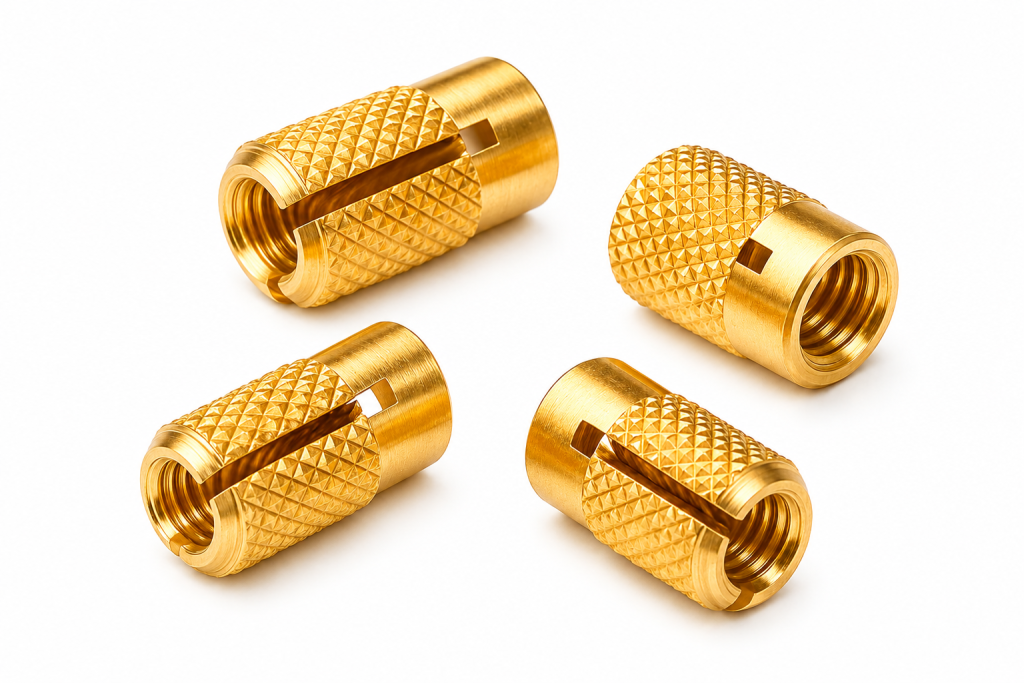
Brass

Parts Delivered Into Supply Chains Including