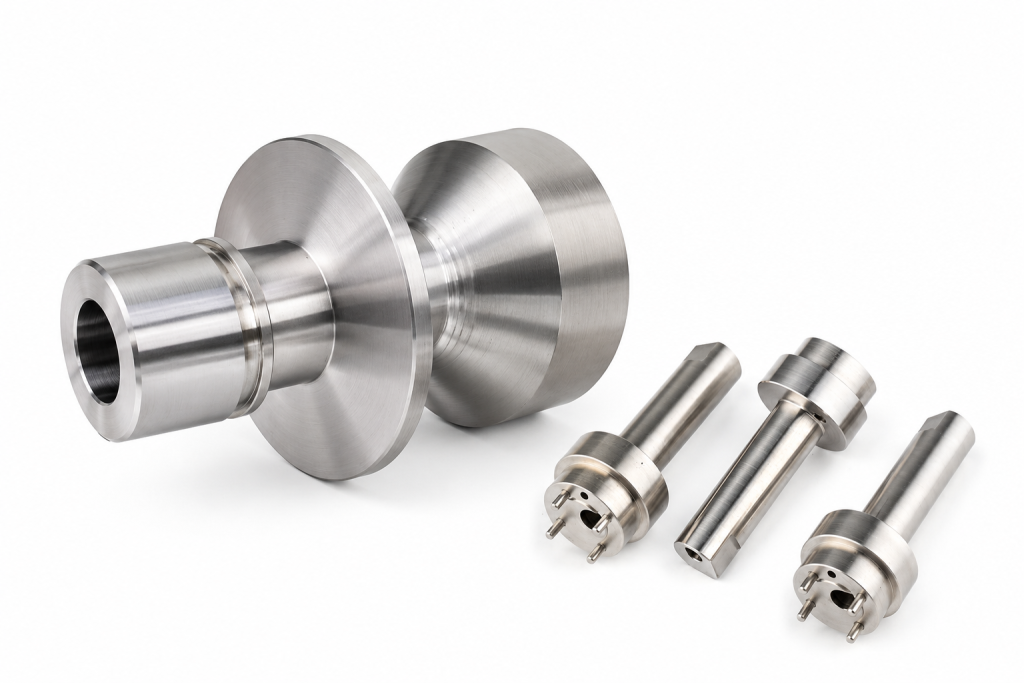
Aerospace-grade strength, biocompatible, seawater corrosion resistance, difficult to machine.
Price:
$0
Lead Time:
< 10 days
Wall Thickness:
0.75 mm
Tolerances:
±0.005″ (±0.125mm)
Max Part Size:
200 cm x 80 cm x 100 cm
Titanium Grade 1
The softest and most ductile commercially pure titanium (99.5% Ti) with excellent corrosion resistance. Suitable Processes: Cold forming, welding, anodizing. Applications: Chemical processing equipment, marine components, and architectural cladding.
Tensile Strength, Yield (MPa)
Fatigue Strength (MPa)
Elongation at Break (%)
VHardness (Brinell)
Density (g/cm³)
240-370
150-200
24-30
120-150HV
4.51
Titanium Grade 2
The standard commercially pure titanium (98.9% Ti) balancing strength and formability. Suitable Processes: Hot forging, machining, laser cutting. Applications: Heat exchangers, surgical implants, and aerospace tubing.
Tensile Strength, Yield (MPa)
Fatigue Strength (MPa)
Elongation at Break (%)
VHardness (Brinell)
Density (g/cm³)
345-550
200-250
20-25
150-200HV
4.51
Titanium Grade 5 (Ti-6Al-4V)
The most widely used alpha-beta alloy (6% Al, 4% V) with high strength-to-weight ratio. Suitable Processes: Casting, CNC milling, 3D printing. Applications: Aircraft structural parts, prosthetic devices, and high-performance automotive components.
Tensile Strength, Yield (MPa)
Fatigue Strength (MPa)
Elongation at Break (%)
VHardness (Brinell)
Density (g/cm³)
895-930
450-550
10-14
330-360HV
4.43
Titanium Grade 9 (Ti-3Al-2.5V)
A lightweight alpha-beta alloy (3% Al, 2.5% V) with superior weldability. Suitable Processes: Tube bending, TIG welding, hydroforming. Applications: Hydraulic systems, bicycle frames, and aerospace tubing.
Tensile Strength, Yield (MPa)
Fatigue Strength (MPa)
Elongation at Break (%)
VHardness (Brinell)
Density (g/cm³)
620-800
350-420
15-18
260-300HV
4.48
Titanium Grade 12 (Ti-0.3Mo-0.8Ni)
A corrosion-resistant alloy with added molybdenum and nickel for acidic environments. Suitable Processes: Hot rolling, pickling, stamping. Applications: Chemical processing vessels, geothermal piping, and desalination plants.
Tensile Strength, Yield (MPa)
Fatigue Strength (MPa)
Elongation at Break (%)
VHardness (Brinell)
Density (g/cm³)
485-620
280-350
18-22
200-240HV
4.51
Titanium Grade 23 (Ti-6Al-4V ELI)
The medical-grade version of Ti-6Al-4V with extra-low interstitial elements for biocompatibility. Suitable Processes: Electron beam melting, polishing, sterilization. Applications: Spinal implants, dental prosthetics, and trauma fixation devices.
Tensile Strength, Yield (MPa)
Fatigue Strength (MPa)
Elongation at Break (%)
VHardness (Brinell)
Density (g/cm³)
860-900
480-520
12-15
320-340HV
4.43
Titanium Ti-15-3
A beta-phase alloy (15% V, 3% Cr, 3% Sn, 3% Al) optimized for cold forming. Suitable Processes: Cold rolling, age hardening, EDM. Applications: Springs, fasteners, and orthodontic wires.
High Strength-to-Weight Ratio: Titanium provides excellent strength while being significantly lighter than steel.
Corrosion Resistance: Exceptional corrosion resistance, ideal for harsh environments.
Biocompatibility: Titanium is ideal for medical industry applications due to its high biocompatibility and non-toxic characteristics.
Durability: Titanium exhibits exceptional durability, making it well-suited for manufacturing CNC-machined titanium parts that endure harsh or extreme operating conditions.
Low Thermal Expansion: Maintains stability under temperature changes.
Non-magnetic: Titanium lacks magnetic properties and boasts excellent oxidation resistance, rendering it highly resistant to corrosive forces.
cons
High Chemical Reactivity: Reactions with gases can cause surface oxidation and embrittlement, weakening components and reducing corrosion resistance.
Heat Buildup: Managing heat buildup is critical due to titanium’s low thermal conductivity, which can accelerate tool wear and affect cut surface quality.
Higher Cutting Forces: High cutting forces required for titanium alloys can lead to increased tool wear, part defects, and vibrations, impacting overall product quality and surface finish.
Residual and Hardening Stresses: Titanium alloys’ crystalline structure limits flexibility during machining, increasing cutting forces and the risk of residual stresses.